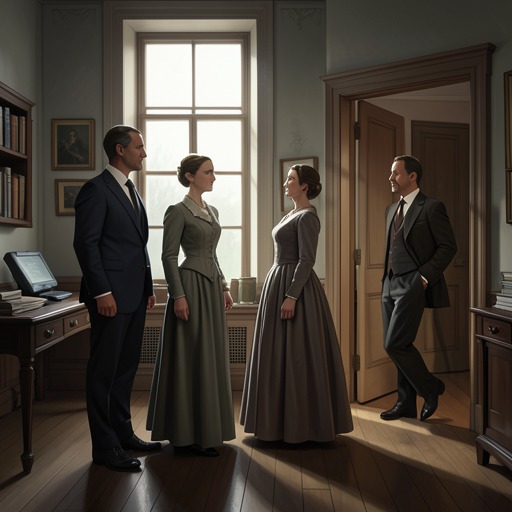
Clare confesses her encounter with Gomez to Henry
The Time Traveler's WifeClare’s confession to Henry about sleeping with Gomez is a disclosure long delayed, and its force lies as much in the fifteen years of fear surrounding it as in the encounter itself. When Clare finally tells him, Henry’s surprise gives way to a response shaped by the date, his own advice, and the intimacy of their life together: he is hurt, but does not turn the revelation into a rupture.
The Secret and Its Delay
Clare struggles to speak even after Henry has been discussing the reality he wants in their relationship. The narration registers the pressure of the moment as an inward injunction to tell him, followed by silence: she cannot bring herself to say it at once. At last, she tells him she slept with someone. Henry’s face becomes frozen and disbelieving; he asks who, and Clare names Gomez.
The disclosure is not recent. Clare explains that she was drunk at a party in 1990, when Charisse was in Boston. She has kept the encounter to herself for fifteen years, fearing that Gomez might say or do something that would expose it. The duration of that fear makes the confession more than a report of past infidelity: it reveals how secrecy has shaped Clare’s apprehension of both Gomez and her marriage.
Henry’s Response
Henry first asks why, then learns when it happened. On hearing that the encounter was in 1990, he laughs with relief and explains that he had thought Clare was telling him about something from the previous week. The date changes the immediate stakes of the conversation. He is not pleased, but he recalls that he has just urged Clare to go out and experiment, and therefore finds it difficult to condemn her without qualification.
His questions do not erase his reaction. Henry asks how the encounter was, and Clare describes it as physically awkward and lacking finesse; she recalls that Gomez smoked during sex. Henry winces. Clare goes to him, apologizes, and says it was a mistake. He pulls her close and strokes her hair, telling her it is not so bad. His response holds discomfort and comfort together: he does not pretend to welcome what happened, but neither does he withdraw from Clare.
Marriage, Candor, and Consequence
Clare begins to say that she had been waiting patiently, but cannot finish. Henry’s gesture of stroking her hair and his reassurance allow the conversation to continue without turning into a separation. He asks whether there are any other surprises; Clare says there are not. His remark that she can keep a secret underscores the distance between the trust she wants and the concealment she has practiced.
The exchange ends without a clean return to how things were. Clare can tell that she has altered in Henry’s eyes. That change is the confession’s lasting consequence: the couple remain physically close, but their shared understanding must now include an episode Clare had withheld for fifteen years. Henry’s reaction is neither a declaration that nothing matters nor a dramatic break. The scene makes room for injury, context, apology, and renewed closeness at once.
Narrative Timing and Significance
The confession’s force depends on the novel’s disordered chronology. Clare’s account identifies 1990 as the year of the encounter, while the disclosure occurs in a later conversation with Henry; the passage makes the reader encounter the secret as a present disturbance even though the event itself belongs to the past. Henry’s relief when he hears the date shows how strongly the perceived recency of an event governs his first response.
The episode also turns Henry’s counsel back upon him. Because he has just encouraged Clare to experiment, his own words complicate any claim to uncomplicated reproach. Yet the encounter still matters: he winces at Clare’s description, and she fears that his view of her has changed. By keeping both those reactions in view, the scene presents candor not as a guarantee against pain but as the act that allows an old secret to enter the marriage openly.